


Winter cereals are the main bread crops that ensure food security and the export potential of our country, so special attention is paid to growing them.
This winter's weather is absolutely atypical for Ukraine: in the first two winter months the temperature varied between –2–30C and +5–70C by day, with no snow cover. These factors can lead to substantial plant exhaustion. Even those late crops that look better now, if exposed to adverse weather over the next two months, may lose much of their yield potential.
As plant pathologists note, the present situation favors the development of most fungal pathogens, which can also adversely affect the formation of cereal yield components. At the same time, the forecast published at the end of January this year by the NAAS is cautious enough in its predictions, since it is unknown what the weather will do over the coming months. In practice, during inspection of winter wheat crops in the southern region, disease infection was noted. In addition, part of the crops have overgrown, so even a few days of snow cover could cause a stronger manifestation of diseases. In some regions, because of moisture shortage, the soil is completely dry at a depth of 20–30 cm, which can considerably slow plant development in spring.
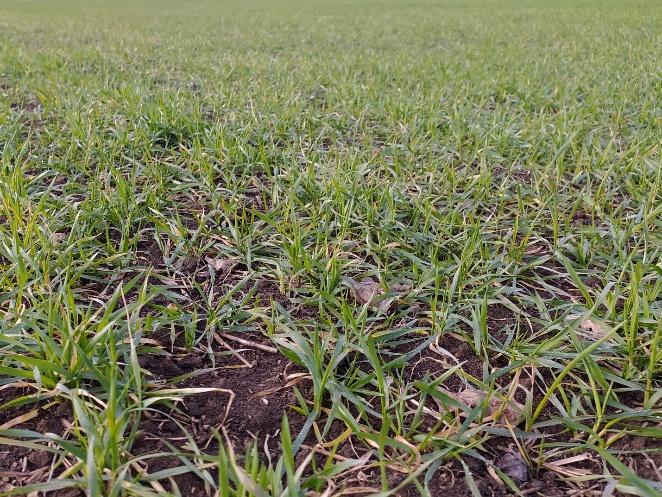

State of winter wheat crops. Odesa region. January 2020
All these factors give grounds to speak of the need to differentiate and possibly intensify early feeding of winter crops.
In our opinion, the following special fertilizers will be most needed in the early spring period:
- Products containing phosphorus in the form of phosphite (1.0–1.5 l/ha), as a supplement to fungicides and growth stimulators. Thus the most popular ECOORGANIC phosphite fertilizer ECOLINE Phosphite (K), besides its fungicidal action, stimulates root system development, helps raise plant resistance to adverse weather and supplies plants with phosphorus, which is needed for uptake of nitrogen and potassium at low temperatures.
Complex compositions with micro- and macroelements (1.0–2.0 l/ha), to stimulate more active physiological processes in the plant (for example, ECOLINE Magnesium (Chelates)).
If plant exhaustion continues and weather conditions worsen in February–March, it will be relevant to give plants an additional energy source at resumption of vegetation. To help plants overcome stress and supply them with nutrients in the form of amino acids, we recommend a special fertilizer with readily available phosphorus (phosphite) and a microelement complex with amino acids - ECOLINE Phosphite (K-Amino) (1.5–2.0 l/ha). To correct the plants' phytohormonal balance, feeding with a complex of macro- and microelements (including molybdenum, zinc, copper) with amino acids, the optimal choice is ECOLINE Universal Growth (Amino) (1.0–1.5 l/ha)
Whatever situation develops in your fields, ECOORGANIC representatives are ready to help select optimal products or develop feeding systems both for winter crops at the resumption of vegetation and for seed treatment or nutrition of spring crops.
Exclusively phosphite forms of phosphorus in the highest concentrations, compositions with microelements and biologically active substances, excellent compatibility in tank mixes with crop protection products and boosting their effectiveness thanks to buffering properties and, at the same time, an affordable price – these are the features that set ECOORGANIC products apart on the Ukrainian market.