

Corn can form a large yield of grain and by-products, whose incorporation into the soil improves the balance of organic matter, one of the most important indicators of its fertility.
Crop productivity depends largely on the level of supply of critically important nutrients at the 4–6 leaf stage, when active growth of plant vegetative mass and the start of the generative phase must be ensured. The cold, prolonged spring of 2022 with moisture shortage in the vast majority of regions sharpened the manifestations of deficiency of phosphorus and zinc, nutrients that are especially important in this period.
The role of zinc in corn nutrition is many-sided, but the most important in the early stages of development is:
- stimulating the synthesis of the growth hormones, auxins;
- releasing reserve nutrients from the seed;
- influence on the formation of ear yield components.
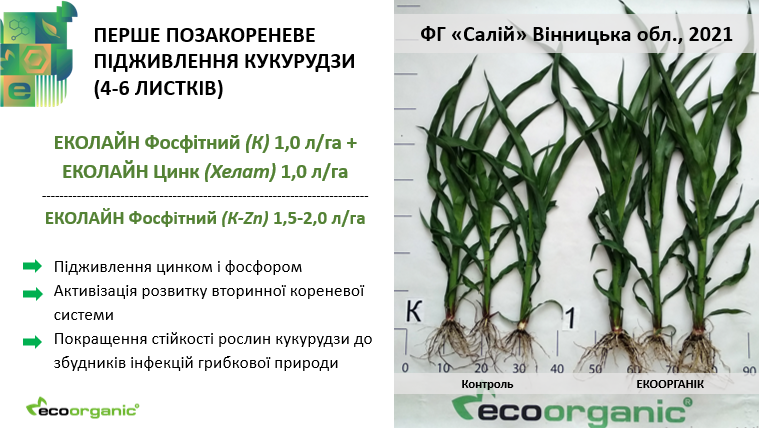
To prevent or eliminate zinc deficiency at the 4–6 leaf stage we recommend foliar feeding of corn with the microfertilizer ECOLINE Zinc (Chelate) at 1.0 l/ha (it can be applied together with post-emergence herbicides).
When deficiency of both phosphorus and zinc is noticeable, it is advisable to use for foliar feeding the fertilizer ECOLINE Phosphite (K-Zn) at 1.5–2.0 l/ha. This special composition, containing phosphorus in the form of phosphite, was developed to eliminate deficiency of phosphorus, potassium and zinc and to strengthen root system growth.
In the case of pronounced phosphorus deficiency, in particular during cold spells, and with poor root system development, we recommend a combination of foliar fertilizers ECOLINE Phosphite (K) 1.0–1.5 l/ha and ECOLINE Zinc (Chelate) 1.0 l/ha. This approach will not only help the plant overcome phosphorus and zinc starvation and activate development of the secondary root system, but will also significantly strengthen the immunity of corn plants and their resistance to fungal infections. It should be noted that, according to independent studies, phosphites at the recommended doses did not suppress soil life but, on the contrary, promoted better development of agronomically valuable groups of microorganisms in the soil.